




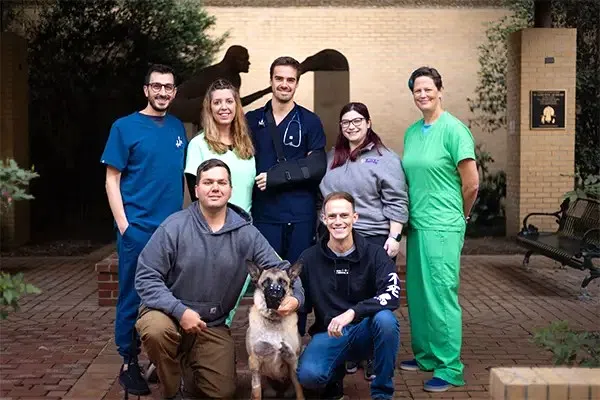
Thanks to LSU’s School of Veterinary Medicine, a military working dog suffering from Addison’s Disease got the life-saving treatment she needed. Astra, an eight-year-old Belgian Malinois, had an elevated heart rate, was lethargic, and was vomiting. The U.S. Army decided to med-evac her to LSU, and Dr. Patty Lathan’s team at the Vet school quickly went to work.
“She responded really well already, from the time that she arrived in the hospital, with the management overnight. So she was looking better already, and then we started giving her the steroids that she needed, and she started perking up quickly,” Lathan said.
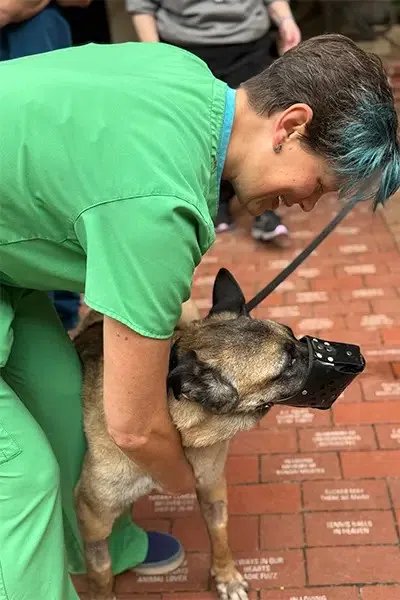
Dr. PATTY LATHAN and ASTRA (photo: Sandra Sarr/LSU Vet Med)
Addison’s Disease is the result of a severe lack of cortisol and a hormone that controls blood volume and electrolyte concentrations – basically what happens when your body doesn’t have any steroids. It affects both dogs and humans. Lathan has it herself and says it can lead to a life-threatening complication called adrenal crisis.
“That’s what we call it when they’re really sick with it; hypovolemic shock or just ‘shocky.’ Then they definitely are critical, and could potentially die from it if they’re not treated appropriately,” Lathan explained.
Military working dogs are highly trained canine service members in the U.S. Armed Forces and are essential for roles like explosives and narcotics detection. She has protected U.S. presidents and has assisted soldiers in Middle East war zones. Lathan says Astra is expected to make a full recovery.
“We’re honored to have had Astra here. I’m thrilled to be working somewhere that we’re able to work with all of this different expertise to get patients treated as well as they can be,” Lathan said.
The LSU Vet Med diagnoses about one case of Addison’s per month in dogs brought to LSU. The disease is significantly more common in dogs than in people.